Showing posts with label Control Societies. Show all posts

Saturday, February 19, 2011

Democracy’s Prisoners of Conscience

Steven Johnston
University of South Florida

The moral and political impoverishment of the Republican and Tea Parties manifest themselves almost daily. How do they respond to political assassination and multiple murders, facilitated by handguns, in Arizona? Celebrate the Second Amendment as a guarantor of American freedom and advocate arming the citizenry with concealed weapons. How do they respond to activist conservative courts that deem unconstitutional even modest health care reform designed to remedy evident injustices? Denounce the evils of government action and hail the decisions as a restoration of American freedom.
If conservatives were as steeped in American constitutional traditions as they believe, they would recognize the absurdity of the first position and the irrelevancy of the second. Freedom and democracy are at risk in the United States and elsewhere, but not because of the specter of gun control or mandatory health insurance (or tax increases, government spending to create jobs, reproductive rights, government regulation, or budget deficits).
The United States, in the first decade of the 21st century, already enjoys two wars to its credit, one patently illegal, the other a miserable failure whose needless, unjustifiable continuation renders it criminal. The country has inflicted great constitutional damage at home and killed tens of thousands of innocents in Afghanistan and Iraq to prosecute these wars. On these questions, however, we hear no protests from the newly installed Republican majority in the House of Representatives. Nor do we hear anything other than bromides about national security from new Tea Party-backed members who prefer to treat the Pentagon budget, which sustains an unprecedented global empire, as more or less untouchable, despite vague pronouncements that everything is subject to fiscal review. Nor do we hear anything from the gun-toting public whose weapons supposedly protect our freedom from government malfeasance.
Once upon a time, a well-armed American citizenry might have opposed national military aggression and aggrandizement. In theory citizen militias resist tyranny at home and refuse imperial aggression abroad. No such convictions inform a professional mercenary army, which the United States deploys (patriotic protestations to the contrary notwithstanding), let alone individual gun owners. The Second Amendment, despite the ideologically-driven decision of an activist Supreme Court, is a collective rather than an individual right. Historically it did bear a certain relation to freedom—but no longer. America is a country awash in guns, but in the last fifty years this didn’t prevent, for example, either Vietnam or Iraq. The Second Amendment signifies nothing more than a consumer’s “right” to satisfy a socially dangerous fetish. The same can be said with opposition to health care, which supposedly relates to the much vaunted freedom of choice in the marketplace.
A democratic notion of freedom lies elsewhere. This is why the dominant responses—ranging from silence to cheerleading to assistance—to Julian Assange’s political persecution are so disturbing. The hysterical diatribes of Joe Biden and Sarah Palin are to be expected; Rachel Maddow’s disgraceful, ignorant December 15 performance on David Letterman and Bill Keller’s nasty, self-serving calumny in The New York Times Sunday Magazine (a friend of the prosecutor brief for the likes of Eric Holder) less so. Of course, The New York Times loves to trumpet its own civic “virtue” and “responsibility,” which Keller does in the Assange piece, perhaps forgetting how the paper marched in lockstep with the Bush Administration’s campaign for war in Iraq in 2002 and 2003. Ironically, The Times and other media outlets are now in the process of establishing their own electronic “drop boxes” for the deposit of classified and confidential material.
As Assange pointed out in a 60 Minutes interview aired on January 30, WikiLeaks’s political and publishing activism fall well within the American political tradition of opposition to established authority. This seemed to escape the sensibility of 60 Minutes correspondent Steve Kroft, who chided Assange for his surprise that the United States would target him for retaliation for WikiLeaks’s exposés, deeming it natural and therefore somehow unproblematic rather than a further abuse of power. Despite America’s (unwarranted) indignation, WikiLeaks opposes illegitimate and abusive exercises of power—corporate or governmental—regardless of country. The idea is to create a more just society, to which freedom contributes, to which WikiLeaks contributes. And democratic freedom is a political phenomenon that finds its finest expression through action-in-concert. One might think here of recent events in Tunisia, abetted by WikiLeaks, or current events in Egypt
As for Assange, when the freedom of one is at stake, so is the freedom of everyone. It is the responsibility of democratic citizens to condemn and resist the state when it threatens not just a single citizen’s political rights, but the liberty of us all by focusing its efforts against a single citizen. This is what we owe Julian Assange and the citizen-and-prisoner of conscience that allegedly provided WikiLeaks with information, Bradley Manning. Eric Holder is doing his secretive best to dust off the Espionage Act of 1917, which Woodrow Wilson used to brutally suppress dissent during World War I, and make it work against Assange.
One democratic organization doing its best on behalf of Assange is Anonymous, a protean cross-state, transnational political force armed with a new set of civic skills to intervene effectively (in part, covertly) against corporate and state assaults on freedom. Like Assange and WikiLeaks, members of Anonymous risk arrest, prosecution, and prison as they resist and seek to reverse undemocratic practices and regimes
The United States does not enjoy a robust history of living up to First Amendment ideals. WikiLeaks has provided the country with another opportunity to match democratic promise with performance. No doubt Obama will lead the way in blowing it. With luck, he will be a one-term president. The time for the democratic left to oppose his renomination is here. He ought to pay the ultimate political price for his repeated democratic betrayals, both at home and internationally.

Monday, February 14, 2011

Perturbed as heck, and we'll take it for a little more: The Banality of Lying in Politics

Emily Beausoleil 
University of British Columbia

The recent piranhic media frenzy surrounding Wikileaks and its founder Julian Assange almost immediately calls to mind the Pentagon Papers leaked exactly 40 years ago; where, though a mere 7,000 Xeroxed documents compared to Wikileaks’ hundreds of thousands, the government claimed the damage to national security was so great that it required stopping the presses – an order thankfully overruled by the Supreme Court and dismissed by seventeen newspapers; where the Espionage Act was first used as an Official Secrets Act, for which it was never intended; where the government similarly demanded the ‘return of information’; and where Ellsberg was likewise accused of treason rather than patriotism. 

And just as in Ellsberg’s case, too, the contents of this year’s July leak was found, as described in a recently released Pentagon letter, not to compromise security in any way, despite claims by US Secretary Robert Gates and Joint Chief of Staff Adm. Mike Mullen, among others, that Assange and his team had ”blood on their hands.” 
Certain differences present themselves, of course: where Nixon worked covertly via the order for a dozen Bay of Pigs veterans to “incapacitate Ellsberg totally,” now Democratic Party consultant Bob Beckel can call for the illegal assassination of Assange on public television, as President Obama’s administration makes moves to create an explicit Official Secrets Act. But like the Pentagon Papers so long ago, Wikileaks has, in the words of an international group of former intelligence officers and ex-government officials who wrote in support of Assange, “teased the genie of transparency out of a very opaque bottle, and powerful forces in America, who thrive on secrecy, are trying desperately to stuff the genie back in.” 
Secrecy and deception are a part of politics, though they inevitably inhibit accountability and public capacity for informed decision-making. As in the case of Vietnam where spin doctors and strategists alike overlooked intelligence documents that noted early on the improbability of winning the war, or the more recent manufacture of weapons of mass destruction in Iraq and a democratically unelected president George W. Bush, or the official claims of combat with armed ‘insurgents’ revealed as false by Wikileak video footage, during the now-famous 2007 killing of 18 Iraqis, including two Reuters journalists, deception is bred into the bone of politics – perhaps it always was. As Ellsberg states in a December interview with Amy Goodman, 
“We’re in an absurd position here with a close down of public discussion of official matters, very similar to that of China. In fact, I even wonder whether there’s a rule that absurd in China. And that’s the kind of information system, I think, that 
our leaders aspire to, and have for a long time.”

But what is striking about this recent case of disclosure is the difference in public response: compared to the public outcry of the 1970s, which ignited protest, fuelled a social movement, and catalyzed the end of the Vietnam War, the public is strangely silent in 2010. Well, not silent, surely – but rather than an eye for the content of these released documents and their implications for democratic transparency and government accountability, all eyes are on Assange, this striking figure stepping on the world stage and the concomitant personal scandal that erupted with impeccable timing; all eyes are on the guerrilla warfare waged in cyberspace between Anonymous and various corporations. Even the accused original source, Bradley Manning, who has been in prison since May, receives his share of media coverage, though the messenger has far more been the target. But with the exception of the New York Times, the actual deceptions revealed by these documents have been all but abandoned by the US media, and likewise public response has been a resounding shrug. 
We’ve gotten pretty good at shrugging, in liberal democracies. A negative definition of freedom helps, of course, construed as the right to be left-the-heck-alone. And since western world leaders saw the atrocities the everyman was capable of during World War One, such passivity has been at times actively cultivated, beginning most famously with the work of Edward Bernays, nephew of Sigmund Freud and originator of the field of public relations, who was employed by corporations and the US government alike to use marketing strategies to siphon this dangerous energy into safer channels. Indeed, Carol Pateman made clear some years ago how such democracies function through, rather than in spite of, the passivity of the majority of the population. What kind of stability, what kind of continuity, could be assured after all, if politics had to make room for the torrent of people who presently feel there is no point? Martin Luther King Jr. makes a similar observation regarding the political power of inaction when he writes from Birmingham Jail that “the Negro's great stumbling block in his stride toward freedom is not the White Citizen's Councillor or the Ku Klux Klanner, but the white moderate, who is more devoted to ‘order’ than to justice; who prefers a negative peace which is the absence of tension to a positive peace which is the presence of justice;...who lives by a mythical concept of time and who constantly advises the Negro to wait for a ‘more convenient season’.” 
But what strikes me about this recent shrug to political deception is how it reveals a general acceptance of lying in politics. We know, don’t we? Are we surprised? The lying in politics that Arendt identified as a core threat to democracy, whether through conscious concealment or unconscious ‘defactualization’ via fidelity to theory, seems now to be only one aspect of, as Raymond Williams first coined it, a “dramatized society.” We live in a culture where the line between performance and reality, between artifice and authenticity, between politics and popular culture has become increasingly blurred. Where identities are cultivated like manicured gardens on facebook, where news stations parade their bias and peddle infotainment, where ‘reality shows’ are clearly staged, where a comedian testifies in character to the Supreme Court and an actor lives and breathes the role of a untalented rapper for two years, where bands are formed around boardroom tables and elaborate hair products can give you that unkempt look, where hipster ‘irony’ comes full circle to earnestness the longer one’s nonchalance is honed and insouciant moustache remains intact. We live in a culture of explicit artifice, and, like the Cubists who were arguably the first to draw explicit attention to the surface within their work, we are aware, very aware, of how much the medium is the message. And yet, as opposed to the Cubists, perhaps, this general awareness of and conscious play with surface is itself somehow less earnest – as if, rather than unveiling a latent truth or essential core, it’s turtles all the way down. In the face of acknowledged artifice, it seems a natural response to cultivate studied indifference and a world-weary arch of the eyebrow. As any middle-schooler will tell you, it’s better to opt out than be the fool. 
This movement to a culture of explicit artifice is paralleled, interestingly, in the world of US cinema, which moved from Method acting’s earnest soul-searching and commitment to the ‘gritty truth’ by actors like Marlon Brando and James Dean post-WW2 – where actors were in therapy as a matter of course and playing Blanche Du Bois almost drove Vivien Leigh insane – to what film historian David Thomson calls “cool pretending” that defines current cinema acting, epitomized by Meryl Streep and George Clooney, where one has a sense the character leaves no traces once the role is cast aside; indeed, that actors are not quite fooled by their own performance, and you have been let in on the joke. 
The pledge to sincerity and emotional truth that defined Method acting have been replaced by a predominance of deft skill and “naked pretense” (which, Thomson says, “you could call...lying, as much as acting”), founded on “a way of looking at the world that says you can't trust anyone, can you? It suggests that—for the moment at least—we have given up on self-knowledge and feel ourselves being massaged or directed by most of our presidents, and nearly all of our eternal performers from Johnny Carson to David Letterman... Presidents move us from time to time, just as hosts make us smile, but most of them warn us that we're in a play or a game.” Such is the contemporary condition in liberal democracies, where sincerity is suspicious and earnestness appears ironic, if not tragic-comedic. 
In a culture where the line between reality and performance is unclear and constantly on the move, it is no wonder, perhaps, that the vocabulary of recent presidential debates has been lowered to a sixth-grade level in response to common conflations of eloquence with insincerity. It is no wonder, perhaps, that comedian John Gnarr is Reykjavik’s latest mayor, and platform promises of a polar bear display at the zoo, free towels at public swimming pools, and coalitions only with parties who have watched all seasons of “The Wire” are more earnest than they first appear. And it seems perfectly appropriate that comedians hold a political rally to restore sanity, while the rise of flash mobs across the western world invokes and enacts a public sphere formerly reserved for public protest – fleeting publics and collective acts now simply for their own sake, as if the performance itself provided a sense of concrete experience and sincere collective that are otherwise absent. Perhaps these performances are an unlikely source of a surrogate ‘authenticity’ – at the very least, they provide respite by explicitly naming the predominance of veneer that is often as obvious as it is undeclared. 
Part of this movement towards explicit artifice is part and parcel of an increasing reflexivity regarding the situated nature of all knowledge-claims, the partiality of perspective – from anthropologists and theorists to jazz musicians, scientists and performance artists, responses to the dangers inherent to claims of ‘authenticity’ and ‘neutrality’ and the ethical obligation to acknowledge the performance within every account have been broad and diverse. And part of this is also, at times explicitly, a response to the lack of such humility within current polemics and fundamentalisms – refusals to, in William Connolly’s terms, “insert a stutter in one’s faith,” that have recently fuelled such vitriol and fear, inhibited reflection, and cultivated new enemies where once were none – perhaps this movement to explicit artifice is a response, if not a conscious call, to calm down, take a deep breath, and count to ten. At the very least, to take a closer look at the medium of the message. 
But one effect of this culture of explicit artifice seems to be a contribution to the politics of inaction. As opposed to the public outcry of the 1970s after the release of the Pentagon Papers that belied a faith in political sincerity and media objectivity now betrayed, we have no such faith. Hence the absence of collective moral outrage, for the fact is that we know we are being deceived; and, in the passing of time and as the facticity of deception becomes one reliable truism, we’re no longer ‘mad as hell’, and yes, I suppose, we’ll take it for a little more. 
Shielded by ironic distance and a rueful grin, armed with sarcasm and a noncommittal shrug, we acknowledge the pervasiveness of veneer, and clear-sighted rather than wide-eyed, we are in on the ruse; we may not know what lies behind it, but at least we recognize the pageantry. We may not know where to direct our dissatisfactions or how to give effective shape to a creeping sense that things are not as they should be, but at least we can’t be called naive. We’re in on the joke, no? Isn’t that something? 
This general acknowledgement of artifice that courses through all levels and arenas of contemporary western culture need not only lead to inaction – as comedians-cum-unlikely-heroes and flash mobs make clear, the performative nature of everyday life might itself offer latent possibilities for collective action. While the potential directions for such collective awareness are rhizomatic and undetermined, I wonder what forms of action might emerge in the absence of recourse to ‘sincerity’ as such – or if, indeed, sincerity might be recuperated, in some form, in the process. This challenge brings to mind another: making “one’s life a work of art,” as Nietzsche and Foucault describe it, requires both brutal honesty regarding the artifice of one’s life and commitment to it nonetheless – both clear-sighted and wide-eyed, somehow. A moving target of a goal, far removed from either entrenched fundamentalisms or evasive apathy. But perhaps it signals a possible, if tenuous, if elusive, model we have yet to recognize in response to a culture of artifice; that, rather than a politics of inaction, such artifice carries with it an ethical demand that is not grounded on essential identity or universal truth, but something else...something else...Damn, it moved.

Monday, January 24, 2011

The Geopolitics of Motherhood

Alex Barder
Johns Hopkins University

Amy Chua, professor of law at Yale University, recently published a controversial essay in the Wall Street Journal entitled “Why Chinese Mothers are Superior.” This essay is essentially an excerpt of larger book entitled Battle Hymn of the Tiger Mother recently published by Penguin Press. The object of her essay is to provide an explanation for why Chinese students are “stereotypically successful.” Chua argues that the Chinese mother child relationship is one defined by an overwhelmingly strict regime of rules and expectations coupled with ample forms of humiliating criticism when those rules are broken or when expectations are not met.
Pretty much everything that kids today take for granted, from watching TV to playing computer games and even (interestingly enough) acting in a school play, is verboten under this regime. Instead, classical music, math and science are, unsurprisingly, privileged. Chua ultimately argues that this form of parenting works best to induce a measure of self-respect through excellence. Indeed, throughout the article, Chua makes no effort to disguise her own disdain for “Western” concerns with the child’s psyche and self-esteem which leads to indolence and weakness. Her argument has naturally provoked a wide variety of responses, from horror at what is perceived as abusive child-rearing to outright approval. Others have righty criticized Chua’s untenable binaries between Western and Chinese mothers and their values, or whether all or even most of Chinese mothers raise their children as she does.
Whether or not the so-called ‘Chinese/Chua mother’ approach is the necessary one to raise successful children is obviously open to question; and I have my own serious doubts about its assumptions and arguments. But what makes this article particularly interesting is that it comes at a time when there is a rising fear of decline in the US imperial position in the world, especially with respect to China. Chua’s article on pedagogy resonates between familial insecurity about the future, the shattering of the American dream for the vast majority of Americans in the aftermath of the great recession and ultimately about the endurance of American’s political and economic global hegemony. Only, as far I have read, has Judith Warner in a New York Times review inchoately made this point in addressing Chua’s book.
To be sure, the relationship between imperial governance and pedagogy is by no means farfetched. One can go back to Tacitus’ Germania for a critique of decadent and effeminate Roman values and moral education compared with the ‘vigorous’ Germanic youths: of course, this at a time when the Roman Imperium was in its ascendancy in the year 96. But, more recently at least, pedagogy and parenting was of the utmost concern among imperial administrators in the 19th and early 20th centuries. Ann Stoler, for example, has done most to show that “The management of sexuality, parenting, and morality was at the heart of the late imperial project” such that “In the nineteenth century Indies cultivation of a European was affirmed in proliferating discourses on pedagogy, parenting, and servants - microsites in which bourgeois identity was rooted in notions of European civility, in which designations of racial membership were subject to gendered appraisals, and in which ‘character,’ ‘good breeding,’ dispassionate reason, and proper rearing were part of the changing cultural and epistemic index of race” (Carnal Knowledge and Imperial Power, 110, 144). Fear of miscegenation and the influence of local servants on children raised in the colonies were fundamental topics of concerns for colonial administrators who believed that only through a restrictive moral, educational and psychological pedagogy can European self-identity and its imperial project be maintained.
Of course the issue today differs from an overt 19th century imperial concern with race to one of renewed concern with the geopolitical and economic competitiveness of American Empire. It is not by chance that Chua’s article comes on the heels of proliferating news stories about China’s greater than expected military capabilities. A few months ago, for example, James Krask published an essay entitled “How the United States Lost the Naval War in 2015” in which he posits a scenario where the US navy no longer has supremacy of the East China Sea. Recent information on a new Chinese stealth fighter highlights China’s technological military prowess that potentially rivals the US air supremacy. 
On top of military hardware advances is the widespread perception of China’s economic and productive might, its accumulation of enormous dollar reserves and its ability to use its economic position to push its own agenda in various international fora. Whereas China has become the manufacturing giant of the global economy, the US is left with a bloated financial sector whose benefit is largely overstated.
More to the point, much of this concern with American decline is then refracted through a growing idea over the past few years that American public education is in crisis, especially in its failure to adequately train students in science and math. For example, the Programme for International Student Assessment ranks countries on the basis of math and science testing. Its 2009 result reveals that the top five countries for math and science are lead by China, followed by Singapore, Hong Kong, South Korea, Taiwan and Finland, Hong Kong, Singapore, Japan, respectively. The United States ranks 30th in math and 23rd in science. Thus in recent years there has been a growing call to privatize US education in the form of either vouchers for private schools or charter schools as a means of reinvigorating education by dismantling public sector teacher unions.
But Chua’s article it seems to me goes one step further in its explicit argument that culture remains a central aspect for addressing questions of education. Her essay is indeed firmly positioned in the culture war discourse (thus seamlessly appearing in the Wall Street Journal) by emphasizing a rigidly hierarchical family nucleus as the means for reasserting individual control at a time when American families feel a growing social and economic insecurity at home. This return to a concern with parenting, nonetheless, diverts us from the need to attend to the deleterious effects a neoliberal political economy has produced for over thirty years, with its generation of crises, neglect of the infrastructure of consumption, reckless disregard for the environment, production of extreme inequality, disregard for public education and commitment to authoritarianism within organizational life.

Tuesday, January 18, 2011

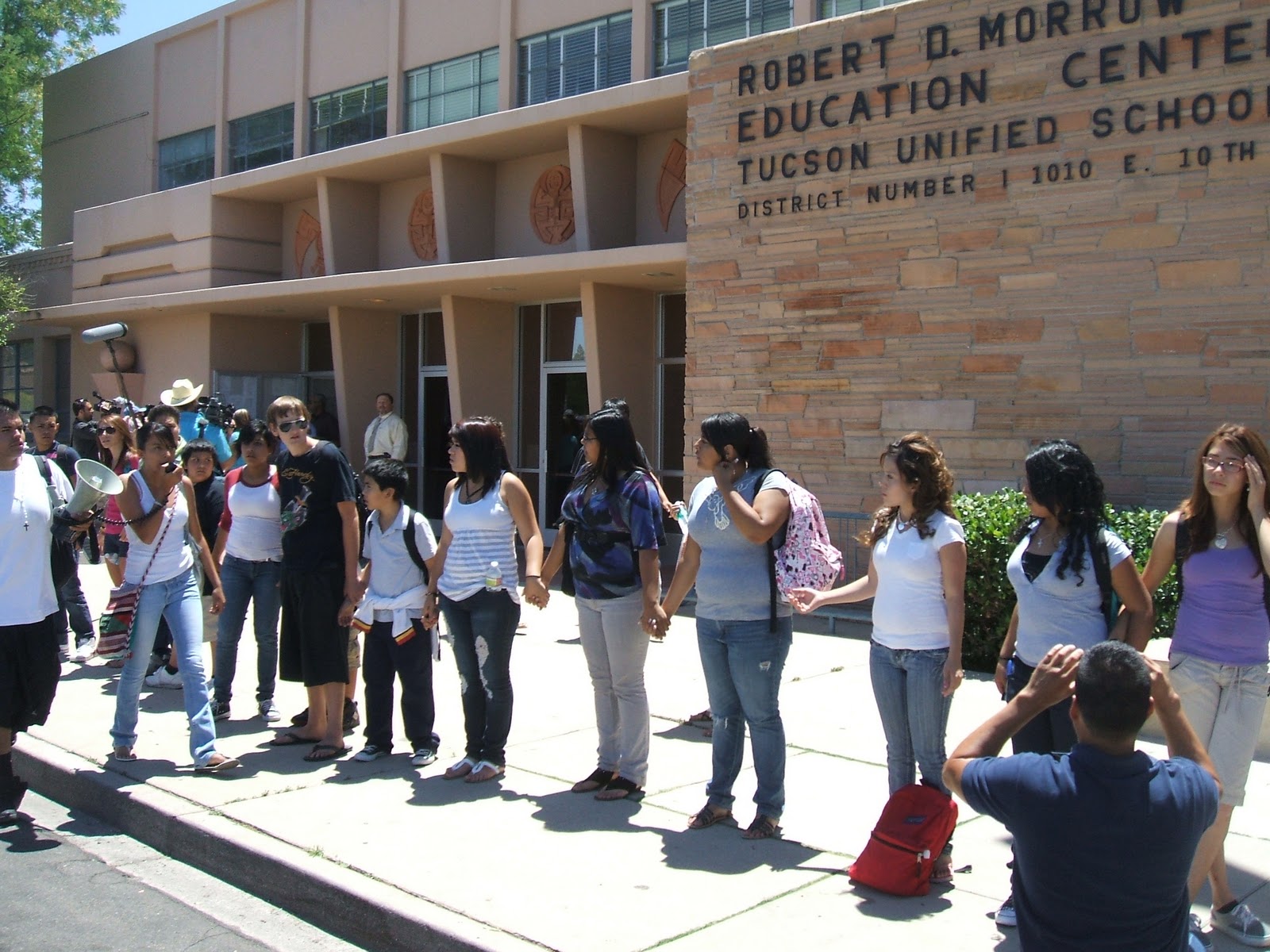
Corruption and Class Struggle: What It’s Like to Live in Arizona Right Now

Joel Olson
Joel Olson has lived in Arizona for over 25 years. He is a member of the Flagstaff Repeal Coalition.
With the passage of the notorious anti-immigrant bill SB 1070 last spring, the outlawing of ethnic studies as of January 1, the gutting of the school and university systems, the collapsed housing market, the high unemployment rates, and now the shooting of Congresswoman Gabrielle Giffords, you might be wondering what it’s like to live in Arizona right about now. 
It ain’t easy. 

But it helps to put Giffords’s shooting in historical perspective, which is defined by two things in Arizona: corruption and class struggle. And ironically, this perspective gives me hope about the radically democratic future of my home state. 
Arizona’s economy was founded on the “Five C’s:” copper, cotton, cattle, citrus, and climate (tourism). These C’s were controlled by big mining and agricultural interests and real estate developers. Corruption was commonplace as they manipulated the political system for their benefit. A group of these capitalists, called the Phoenix 40, controlled state politics until the 1970s, when the political establishment opened up some. But even after their rule, the state capitol has always been a place to lie, bribe, and scam your way to what you want. If the names Don Bowles, Evan Mecham, AZ scam, Fife Symington, or the Keating 5 (which included Senator John McCain) mean anything to you, then you know that corruption is as plentiful as the parking here. And I haven’t even mentioned Maricopa County Sheriff Joe Arpaio or State Senator Russell Pearce, the tweedle-dee and tweedle-dum of racist nativism.* 
SB 1070 and Giffords’s shooting, in other words, are but the latest of a storied history of corrupt cowboy capitalism. 
Such tomfoolery is part of the class struggle in the Grand Canyon State. Three classes matter in Arizona: elites, the white middle class, and the working class. The elites come mainly from the agriculture/mining, tourism, and construction/real estate sectors (with an emerging tech sector). They are the masters of the corruption I described. But in a system of majority rule, elites need a junior partner to dominate. This is where the white middle class steps in. 
The white middle class is the engine of suburban development here. The new housing developments, strip malls, and big box stores that pop up almost daily (until the recession, at least) are built for and fueled by this class. Many in this class run small businesses related to the main sectors of the economy, such as ranching, construction, landscaping, and pool maintenance. Many are retirees who used to manage businesses in other states. This small business atmosphere contributes to the libertarian, Barry Goldwater-style political culture of the state. 
For years, this relationship has been mutually beneficial. While legal segregation never took deep root in this state (most of Arizona’s explosive growth took place after Brown v. Board of Education was decided in 1954), unofficial practices have kept many neighborhoods and schools comfortably white for decades, and the best jobs have been traditionally denied to Chicanos and Natives. (With a Black population of just three percent, the racially “out” groups in this state have historically been Chicanos, Mexicans, and indigenous peoples.) Politicians have successfully tied these practices to the laissez-faire economic policies of the elites, giving whites the sense that their success is due strictly to their own work ethic rather than being facilitated by white privilege. As a result, many white middle and working class Arizonans identify with the success—and conservative politics—of the elites. 
This collusion has created an anything-goes capitalism mixed with a suburban consciousness. Call my state the Wild West or suburban hell—they’re both accurate to a large degree. 
But the partnership has been fraying in the last two decades. Pressures to diversify corporations, universities, and governments have led elites to support various multicultural initiatives, which middle class whites resent. (Arizona voters in November voted to outlaw affirmative action by a wide margin.) The state’s Latino population has outpaced white growth, and the state is now nearly one-third Latino. Areas that were once comfortably white now have Spanish-language business signs. More and more schoolchildren have brown faces—even in the “good” schools. Cars roll down formerly white streets bumping music whose percussion comes from a tuba. 
Further, middle class whites increasingly see elites in collusion with the Brown working classes rather than them. They have reasons for believing this. Agriculture, construction, and tourism all depend on a highly exploitable, low-paid working class, which makes migrant labor desirable. Undocumented labor makes up 27% of all construction workers, 60% of agricultural workers, 25% of restaurants workers, and 51% of all landscaping workers in Arizona. This sets small business interests—who usually can’t take advantage of such labor—into a tizzy. It sets off many other middle and working class whites as well, who feel that “they” are stealing “our” jobs. This is the political power behind SB 1070—a law that Arizona’s elites largely oppose. 
The frayed alliance between these two classes has created the political mess this state is in today. It is the story behind SB 1070, HB2281 (the anti-ethnic studies law), the elimination of affirmative action, the attack on the public education system, the attack on public workers for enjoying “Cadillac” pension plans, and Giffords’s shooting. The alleged shooter, Jared Loughner, is not only of the white middle/working class, his addled mind is a gross exaggeration of its contradictions and confusions. Of course Loughner is probably crazy, but his mental health—and even his ideology—are not the point. What matters is that the conflict over this frayed class alliance—and all the political vitriol it has generated by Tea Partiers and others—pointed his illness toward Gabrielle Giffords. 
In the face of this mess, it is the working class—largely Brown, largely poor, largely poorly educated, largely ignored—that represents the best hope to build a new Arizona within the corrupted shell of the old. Exploited by the elite, despised by many whites, and largely shut out of the political system, this class has had to make its own way through the state’s crazy political landscape. 
With a weak Democratic Party, a labor movement crippled by “right to work” laws, a small civil rights contingent, few political nonprofits, and almost no organized left, Arizona’s working class is turning to grassroots democracy, operating outside the “official” political channels and fearlessly making political demands that challenge the pillars of laissez-faire capitalism itself. This path they are carving is quite possibly a model for working class struggles throughout the nation. 
Take the grassroots fight against SB 1070, for example. The Tierra y Libertad Organization in Tucson has been a leader in opposing SB 1070. But it is also creating a new model of democracy. Declining to become a 501(c)3 nonprofit organization, they raise funds through the community, which they use support their struggle for the self-determination of its base communities. In Phoenix, Puente has organized the major immigrant rights demonstrations in Arizona, but they are also organizing neighborhood meetings throughout the Valley of the Sun. In Phoenix and Flagstaff, the Repeal Coalition (I’m a member of this group) demands that all persons in a global economy be free to live, love, and work wherever they please, and they demand that ordinary people have a full say in those affairs that affect their daily lives. The undocumented workers, moms, and college students who make up the group don’t seem to worry that these demands are deeply radical and disrupt the very functioning of Arizona politics as it currently operates. These groups work with others, such as Border Action Network, No More Deaths, and Arizona Interfaith, that are organized in a traditional nonprofit format but nevertheless encourage face-to-face democracy and are courageously fighting 1070 and myriad other evils. 
These working-class struggles suggest a new Arizona. They suggest a world in which working people decide the fate of the community, not the rich. They suggest a world in which democracy rather than white privilege decides how to allocate resources. They suggest a world in which borders are tools of the bosses rather than walls that “defend sovereignty” or “prevent terrorism.”
This class will not win for a while. The elites and the white middle classes are yet too powerful. This coming year, Arizona politicians will gut the Fourteenth Amendment’s guarantee of birthright citizenship, defund public education until it barely operates, and do many more stupid things. But as elites and the white middle class continue to bicker, the Arizona working class continues to learn lessons, develop leadership, practice grassroots democracy, and make demands that seem “unreasonable” today but might tomorrow become as obvious as the multiplication table. 
Corruption, elite domination, and white favoritism are the most important factors in understanding Arizona’s strange political history, including this latest episode. But class struggle against it is key to understanding why the nation’s strangest state may soon be in the vanguard of struggles for real freedom. Those involved in such struggles stand like saguaros in this beautiful state, even as the snakes and scorpions scurry about us. 


* For the uninitiated or un-Arizonan: Don Bowles was an Arizona Republic reporter who was murdered by a car bomb in 1976 while investigating connections between Arizona elites and the Mafia. Evan Mecham was a racist governor (he was a John Birch Society supporter) from 1987-1988 who was impeached for obstruction of justice and misuse of government funds. The Keating 5 were five U.S. Senators, including Arizona Senators John McCain and Dennis DeConcini, who were accused of corruption in 1989 for illegally intervening on behalf of Charles Keating, whose Lincoln Savings and Loan bank collapsed, causing thousands to lose their life savings. “AZ scam” was a bribery and money laundering scandal that several state legislators were convicted of in 1991. Fife Symington, the governor of Arizona from 1991-1996, was impeached and indicted for 23 counts of fraud and extortion.

Wednesday, January 12, 2011

In the Crosshairs

Thomas Dumm
Amherst College

John Protevi goes a long way toward explaining the absurdity of the demand for billiard ball causality while tracing the influence of rhetoric and propaganda in creating an atmosphere conducive to violence, and how that may have had something to do with the assassination attempt against Congresswoman Giffords. I want to supplement his post by exploring another dimension of the mediated responses to this horror, namely, the Fox News response to the accusation of influence. 
Over the weekend Fox News repeatedly defended Sarah Palin’s cross-hairs imagery, her use of the phrase, “Don’t retreat, re-load,”as aspects of the metaphor used by all participants in American politics. You know, targeting opponents. 
A seemingly chastened Roger Ailes issued a memo to his stable of stars over the weekend, cautioning, “You know, they’re using this thing...apparently there was a map from one of Palin’s things that had her (Congresswoman Giffords) district targeted. So, we looked at the internet and the first thing we found in 2007, the Democrat Party had a targeted map with targets on it for the Palin district. These maps have been used for for years that I know of. I have two pictures of myself with a bull's-eye on my head. This is just bullshit. This goes on... both sides are wrong, but they both do it. I told all of our guys, shut up, tone it down, make your argument intellectually. You don’t have to do it with bombast. I hope the other side does that.” 

Ailes seemed worried that bombast in the face of such a tragic event might backfire. Not so for his troops. 
As his way of “toning things down,” on his Monday edition of The O’Reilly Factor, Bill O’Reilly suggested the following: “The New York Times, MSNBC, Paul Krugman and others, are furious that their far-left vision is falling apart, so they are using a terrible tragedy to attack their perceived political enemies. That is what this is all about, the failure of the far left agenda.” He suggested that President Obama not only call for unity, as he did, earning O’Reilly’s praise, sort of grudgingly, but urged him to go further, and “call out the left-wing thugs.” 
On his January 10th eponymously named program, Glenn Beck dug up a comment that had appeared some time earlier on the Daily Cos – “She is dead to me now,” a reader’s response to Giffords’s refusal to vote for Nancy Polosi for minority leader in the recent House vote – that was scrubbed from the website, attributing it to guilty conscience on the part of its editor. Of course he failed to note that Sarah Palin had done the same thing with her map. He also failed to note that a reader responding to an article by using a common phrase of shunning is not the equivalent of a former Vice-presidential candidate using the images she used as a front page to her website. Beck actually resurrected the map, and mockingly asked “if this map is responsible,” exemplifying Protevi’s billiard ball logic carried to its absurdist conclusion. But he failed to note that Congresswoman Giffords publicly worried about the use of that imagery immediately upon its appearance, and that that hadn’t made Sarah Palin give pause, not one bit. 
But in the main, Beck used his January 10th program to tell a larger tale, trying to reframe the story of the assassination attempt media coverage. He claimed that Loughner couldn’t be pinned down politically. In almost the next breath he noted that Loughner owned copies of both The Communist Manifesto and Mein Kampf (but of course didn’t note that he also had copies of some of Ayn Rand’s work). Beck fitted the entire event into his ongoing narrative about Frances Fox Piven, Van Jones, communists/fascists coming to power by scapegoating conservatives, exploiting existing tragedies to stir chaos and fear, while claiming that none of this narrative is a conspiracy theory, and what is going on in the mainstream media is an attempt to silence or discredit opposition to Obama. “My agenda is the truth,” he said. Fox, he claimed, unlike the rest of the media, did not engage in wild speculation, and a good thing, because Loughner is not a right-wing nut-job, nor a left-wing nut job, but simply a “nut-job.” He suggested that the left always refers to terrorists as individuals, acting on their own, but when it comes to the Right, there must always be the accusation of conspiracy. 
Both Beck and O’Reilly mentioned that they had security details to protect them, because of threats they receive all the time. 
Is there a pattern here? They complain about threats made to them when a Congresswoman who has previously had her offices vandalized, who as recently as the day before her assassin attacked was urging that rhetoric be toned down, when she is laying in a coma, when there are many others dead and wounded. By complaining about being threatened and scapegoated, they remake the story. It no longer is primarily about the killing and wounding, but about themselves as victims, just like Congresswoman Giffords. It is the ultimate in rhetorical jujitsu. Or perhaps it is chutzpah, as in the story of the man who murders his parents and then begs the judge for mercy, noting that he is an orphan. 
My initial response to this attempt to reframe the narrative is that it seems at best to be working at the implausible limits of extreme plausible deniability. But perhaps this move, seemingly an act of desperation, an act transparent to anyone not already among the converted to the Fox narrative of contemporary American political life, can be viewed as an experiment. “How far can we go?” may be the question they are asking themselves. 
 Or, perhaps they are so far down the narrative rabbit hole they have constructed that they believe their storyline, that as Beck put it, “My agenda is the truth.” It is just that the truth is that Frances Fox Piven is responsible, now and always, and Van Jones, and, though he didn’t mention it on this particular program, Woodrow Wilson as well, the evil Democrat founder of progressivism. 
The Terrifying Face of Liberal Fascism 
Frances Fox Piven
Or, perhaps most troubling of all, they know that the power they have at their disposal, an entire network that will endlessly repeat their story line, can turn this lemon into lemonade in the end. If that is so, then we need to think again about new ways to jam the gears of the Fox resonance machine. As Beck says, “My agenda is the truth,” though perhaps he means that in a way slightly different than he explicitly intends. In other words, he has the truth right where he wants it, in the crosshairs, only metaphorically speaking of course. 

LinkWithin

Related Posts Plugin for WordPress, Blogger...