Showing posts with label Joel Olson. Show all posts

Tuesday, March 22, 2011

Youth and the Two Futures of Arizona


Joel Olson
Northern Arizona University

As spring heats into summer in the desert, two Arizonas fight for supremacy. One, lodged in power in the Arizona State Capitol, drafts anti-immigrant and “fiscally responsible” bills with glee. It is old, it is white, it is dour and narrow. The other protests these bills from outside the capitol walls. It is young, it is largely brown, it is hopeful but it is angry, and it aims to clash with the old Arizona. On Thursday it earned its first victory.


Youth protest at the Arizona State Capitol. Photo: Joel Olson.

On Wednesday, one hundred youth from six weeks old to drinking age marched on the Capitol to protest a rash of anti-immigrant bills that, if passed, would have made Arizona’s notorious SB 1070 look like an act of charity. These five bills challenged the Fourteenth Amendment’s guarantee of birthright citizenship and would have required every member of official society—from nurses to teachers to school secretaries to doctors to employers—to check a person’s immigration status before healing or educating or hiring them.

The youngest walked in front, dressed up in costumes that represented what they want to be when they grow up. High school and college students followed them. And so the next generation of doctors, baseball players, construction workers, and firefighters descended on the capitol. They chanted “Our Freedom! Our Future!” and sang the civil rights standard, “This Little Light of Mine.” One 30-foot banner had hundreds of kids’ handprints on it along with written messages to the legislature. Another, carried by middle school students, read “Russell Pearce: Why Do You Hate AZ Youth?”

When they arrived at the capitol they sang, “Jesus Loves the Little Children.” This classic Sunday school song has probably never been sung with such bite, for in singing to the legislature that Jesus loves the children of the world, they suggested that many Arizona legislators don’t. The chants and songs—which could be heard from inside the capitol building—had to prick the hearts of the “Christian conservatives” debating at that very moment how many millions to cut from the public schools and children’s health care.

The Arizona state legislature is firmly controlled by Republicans who represent white working and middle class constituents, including small businessmen and retirees, from suburbs and small towns like Mesa, Gilbert, Fountain Hills, Snowflake, and Lake Havasu City. These white nativist cranks are determined to scapegoat immigrants for the state’s deep fiscal crisis (Arizona is about $3.8 billion in the red) despite the fact that every reputable study shows that immigrants—documented or not—are a net gain to a state’s economy.

Herein lies the secret of Arizona’s nutty nativism: it is the outer shell of an intensive effort by elites to “reduce government” through deep cuts in public education, Medicaid, welfare, and the universities—while actually expanding the power of the state through border militarization and turning police officers, teachers, principals, nurses, and doctors into immigration agents.

Like the anti-union legislation in Wisconsin, anti-immigrant legislation in Arizona is the front line of a conservative attack on the welfare state. The plan: First, blame the recession on “illegals” and public school teachers—but not Wall Street barons. Second, use the fiscal crisis in state budgets to justify deep cuts in public services as a “necessary measure.” Third, tell the public, “Everyone must make sacrifices.” Fourth, (and in direct contradiction to #3), cut business taxes deeply in order to “spur investment.” Fifth, use the predictable loss of tax revenue to justify more extensive cuts in public services, which justifies further tax breaks for the rich, which… well, you see the pattern. In other countries this process would be led by the World Bank and would be called “structural adjustment.” Here it comes from whites of modest means at Tea Party rallies underwritten by the Koch brothers. The whole thing looks particularly absurd in Arizona because our politicians are more obnoxious than elsewhere, but it’s a nationwide affliction.

But this working class nightmare is being challenged by Arizona’s youth, who have a very different vision of the future. Of the three great populist responses to the Great Recession so far (the Tea Party and Wisconsin being the other two), the immigrant rights movement most suggests a new world. The Tea Party, of course, suggests not the future but the past, with its laissez-faire policies turned into populist slogans through white resentment.

The massive demonstrations in defense of public sector workers in Wisconsin have been among the most inspiring in the U.S. in a decade, but it is hard to tell whether Wisconsin signals the birth of a new movement or is the last gasp of the old. Its energized defense of the working class and its occasional militancy inspire fresh hope, but its defense of a long-declining union movement and its overwhelming whiteness make it seem like a struggle from an earlier era.

By contrast, the movement against nativism feels new. Though it began before the recession, with major nationwide demonstrations in May 2006, since 2008 it has had to dig in for the long haul in response to a rash of anti-immigrant bills from Arizona to Georgia. And in doing so, it has not followed the typical paths of movement building by the left. Completely absent at Wednesday’s youth march, for example, were unions, civil rights organizations, and representatives from nonprofits. This protest was entirely from the grassroots, and young people were in the vanguard.

Undocumented parents—who have risked everything for a better life for their families by coming to the U.S.—are understandably hesitant to enter the political fray, although many do. But their children, many of them U.S. citizens and most of them fairly Americanized, are ready to fight. They fear losing their parents and other relatives to ICE raids—as many already have. They are determined to not let it happen anymore. One middle school student at the protest, who has already had two uncles deported, defiantly told to the crowd through the bullhorn, “I don’t want to lose more of my family than I already have.”


Their documented friends are ready to fight, too. In Arizona, if you go to a public school, chances are you have undocumented classmates. As a result, many young people here, including whites, have friends who are undocumented. Empathy for their situation cuts across race and class among these youth. In one speech, a third-grader said, “My friends are endangered and threatened and I don’t want them to go to Mexico and live on the streets.”

So it’s not surprising that youth are taking the lead in the struggle against the nativist teabaggers. High school students throughout Phoenix walked out last week to protest the anti-immigrant bills, many of them marching many miles from their schools to the state capitol. Thousands walked out last spring (video) in the fight against SB 1070, too. And that’s why they marched on the Capitol on Wednesday.

Immediately after the march hit the local news, grouches in the blogosphere complained that the kids were being “used” by grownups in the immigrant rights movement, and that they should be studying or playing rather than being “exposed” to politics at this young age. As if young folks don’t know what’s happening to them! As if they can’t engage in politics and do their homework and watch cartoons, too! (They are a multi-tasking generation, after all.) Such criticism pretends to express concern for children, but they are really just further attempts to patronize and depoliticize young folks, and keep them from shaping their own future.

And then, the youth of Arizona tasted their first victory. The very next day after the march, the legislature fiercely debated all five bills, and all five of them went down in defeat! The Republicans who joined Democrats in voting against them said they were moved by arguments from corporate Arizona that these bills were “bad for business” and a “distraction” to the budget crisis. But kids know they were heard, too. Insiders at the Capitol tell me that the place was abuzz with the youth protest, and that it had them worried: if they are already protesting now, before the bill goes to the governor for her signature, what will they do in the next few weeks? The aura of ungovernability hung in the air. Further, the media has started to discuss how anti-immigrant laws are affecting Arizona’s youth and how nativist legislation is connected to budget cuts. Many are starting to openly wonder how such bills and laws will affect Arizona’s future. They act like they have come up with these questions on their own, but kids know better.

This is only one battle in the fight for Arizona. The nativists, led by Senate President Russell Pearce, will counterattack soon. But the other Arizona, the Arizona that exists in the eyes of its youth, will be ready for that, too.

Arizona’s young folks know how nativism affects their future. And they are not standing for it. While the state legislature seeks to hurl Arizona into a laissez-faire dystopia where brown people are neither seen nor heard, Arizona’s youth are struggling for a new future, one in which they and their families are free to live, to love, and to work wherever they please. This is their state. As a six-year-old told a reporter at the march, “We are here to fight for freedom.”

Joel Olson is a member of the Repeal Coalition, a grassroots organization seeking the repeal of all anti-immigrant laws in Arizona that helped organize the youth event.

Selected media coverage of the march:

Video from NBC Channel 12, Phoenix.

Arizona Republic's lead columnist, E.J. Montini:

"Republican-controlled Legislature wages war on children". (Note how Montini is using the Repeal Coalition's language of ‘hating children’ throughout.)

Arizona State University's daily, The State Press:

"Children Dress in Costume at Capitol Protest"

"Demonstrators Protest Immigration Bills"

Demotix.com:

"Children Join Repeal Coalition Protest at Arizona State Capital"


Saturday, July 24, 2010

Miracles, Democracy, and the Fight Against SB 1070

Joel Olson is a member of the Repeal Coalition, which meets every Wednesday night.  The Coalition can be reached at www.repealcoalition.org or repealcoalition@gmail.com


One by one we go around the room.  Westate our name and why we are here at this meeting, seeking the repeal of SB1070 and other anti-immigrant laws. “I want to keep my family together.” “Ibelieve in human dignity.” “I’m afraid my family will be broken up.” “I believein freedom for all people.”  “I want a resolution to this problem.” “Iwant a new world.”  
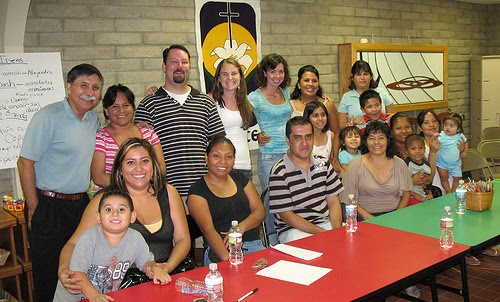
This is what my Wednesday nights havebeen like since the passage of SB 1070 in April:  for three hours Isit in a hot, sweaty room at the local Catholic church in Flagstaff, Arizona,with anywhere from 25 to 50 adults plus a gaggle of little kids.   It’sa meeting of theRepeal Coalition, an all-volunteer, grassroots organization that isstruggling for the repeal of all anti-immigrant laws in Arizona.  Three-quartersor more of the participants are Latino.  About that many areundocumented or related to someone who is.  Women outnumber men, andthey participate more.  The discussion is noisy and animated, andmostly in Spanish, with people doing the best they can to translate intoEnglish or vice-versa.  Often just the gist gets translated.  (Someonesays a joke in Spanish and three-quarters of the room erupts in laughter andthe rest of us smile sheepishly, then someone says a joke in English and itgoes the other way.)  But somehow we feel like part of the samegroup.  The kids in the adjacent room tear through the paper andcrayons and cheap toys until someone pops in a video.  By 8:30 p.m.,exhausted, we clap it out, clean up, socialize, and take care of the littlethings we couldn’t get to in the formal meeting.  Then we all gohome, do the work we volunteered to do, and come back fighting the nextWednesday. This is what democracy looks like.
In Arizona right now, this is the lullbefore the storm.  SB 1070 is scheduled to become law on July 29.  Ifyou don’t know, SB 1070 is the notorious anti-immigrant law that makes it astate crime to be undocumented, requires everyone in the state to carry ID (“Yourpapers, please!”), makes it a crime to give an undocumented person a ride inyour car or a meal in your home, and practically mandates racial profiling. 
On July 29, if the police have “reasonablesuspicion” that you are undocumented, you will be ripped from your family andthrown in jail.
On July 29, if you give a ride in yourcar or allow into your home a person you know is undocumented, you are “recklesslydisregarding” that person’s legal status and can be arrested for “harboring” an“illegal alien.”
 On July 29, if you get stopped by thecops and you don’t have identification on you, this will count as “reasonablesuspicion” that you may be in the country illegally, and you are subject toarrest, no matter where you are from. 
If this sounds to you like the makingsof a police state, well, it does to me, too.
When Governor Jan Brewer signed 1070into law at the end of April, Arizonanstook to the streets in the tens of thousands.  Weorganized protests, held community forums, and spoke out wherever we could: thestate capitol, trailer parks in Phoenix, Flagstaff City Hall, the borders ofthe Tohono O’odham nation, neighborhoods in South Tucson. 
After the crowds died down, the lawyersstepped in.  To date at least six lawsuits have been filed that seekto prevent SB 1070 from going into effect, including one by the Obamaadministration.
Undocumented folks and their loved onesare holding their breath, praying that the lawsuits will succeed.  Butmany of them aren’t putting all of their eggs in that basket.  Theyknow that ultimately, onlygrassroots action will defeat this evil law
Which brings us to the meetings.
Americans generally don’t know how torun a meeting, or participate in one.  We can vote, we can speechify,and we can scream at each other, but we rarely debate constructively and in away that encourages the participation of all.  Our political systemsimply isn’t set up for that.  Instead, what typically happens isthat the people vote once a year or so and the politicians do the work—with thehelp of lobbyists, bureaucrats, judges, and lawyers, lots of lawyers; It’s a really limited form of democracy, when you think about it.
But the meetings of the RepealCoalition are entirely different.  They are utterly ordinary, yetincredible.  The great Marxist revolutionary C.L.R. James once wrotea pamphlet about direct democracy called “Every Cook Can Govern.”  Hewould have been inspired to see these cooks, cleaners, servers, chamber maids,college students, linen service workers, teachers, maintenance workers,warehouse clerks, and cashiers practice democracy in Arizona.  Andthe Coalition doesn’t just go through the motions of democracy like mostAmerican voters; we debate politics.  We cometogether, discuss the right thing to do, develop strategy, make decisions, andcarry them out.  People (mostly) raise their hand to speak and(mostly) listen patiently to others.  And we do all of this in twolanguages!
The political theorist Hannah Arendtclaims that ordinary people directly participating in politics is literally a miracle.  Miracles, she argues, are the spontaneous creation ofsomething new.  This, she argues, is precisely what people acting inthe public sphere do: they create a new beginning, a new community, a newpolitical possibility, something that has never existed before.
That’s what happens every Wednesdaynight in Phoenix and Flagstaff.  At one recent meeting, for example,Flagstaff Repeal discusses the finer points of a resolution we’ve written thatdemands the repeal of all anti-immigrant legislation in the state of Arizona.  Theresolution, which we hope the city council will pass, calls for the city toproclaim itself a safe haven for all people, whether they have papers or not.  Wediscuss and then approve the resolution unanimously, to great applause.  Wethen move on to developing strategy for how to get the city council to pass it.  Fromthere we discuss the situation of some undocumented workers who have beenunjustly treated and fired by the local Hampton Inn, and then to plans for aprotest and march against SB 1070 in downtown Flagstaff for the comingSaturday.  The facilitator (who is doubling as translator) gets usthrough the agenda so that we can end by 8:30.  We all marvel at whata great job she did—and it was her first time.  The meeting ends by “clappingit out,” or a slow, disorganized clap that increases in speed andsynchronization, leading to a crescendo of group unity and power until itbursts into individual applause again, reminding us of how the individual andthe collective are interdependent.
These meetings are inspiring, boring,disciplined, way off track, frustrating, empowering, intimidating, and awesome—oftenat the same time.  Like I said, this is what democracy looks like.
The Repeal Coalition’s slogan is “Fightfor the freedom to live, love, and work wherever you please.”  Butthis slogan is meaningless without another: “All people deserve the right tohave an equal say in those affairs that affect their daily lives.” Democracy isnot voting for elites every four years while quietly fuming at the tyranny ofyour boss for 40 hours a week (more if you’re undocumented).  It’sthe ability of all people to have a say in those affairs that affect theirdaily life.  At our meetings, we seek to live out this principle ofradical democracy.  It’s built into the very heart of the RepealCoalition: the weekly meeting.
The Repeal Coalition has been meetingevery week since March 2008.  For the first few months there werebetween a dozen and 20 people.  Sometimes there were four of us,staring at each other, wondering what the hell to do next.  That wasthe case last January, for example.  Thanks to an inside source, weknew the notorious bill that would soon be named SB 1070 was coming, evenbefore it was made public.  We talked about how we needed to build amovement to fight it.  But there were just four of us.  Whatthe hell could we do?
And then in April the world discoveredSB 1070, and we went from six people to 40 to 60 in two weeks (plus 20 kids—Ispent several meetings doing childcare in the adjacent room, occasionallysticking my head in the meeting room to hear what was going on).  Theprimary language went from English to Spanish.  The college students,who were formerly a majority in the group, became outnumbered by servers andlaundry workers.
Since then we’ve had at least 25 peopleat every meeting.  We’re busy, but we’re nervous.  July 29approaches.  People don’t know yet how they are going to keep theirfamilies together.  They are scared to drive, so they aren’t evensure how they’ll get to work, how they’ll get their kids to school, how they’llshop for groceries.  Down in Phoenix, Sheriff Joe Arpaio calls July29 the “magic day” when he can truly begin to sweep the streets clean of brownpeople.
Another political theorist, CarlSchmitt, argues that the real miracle in politics is what he calls “theexception.”  This is when a ruler declares an “extreme emergency” andsuspends the rule of law.  SB 1070 isn’t quite a miracle in thisrespect, because it is the law, even if it does suspendliberty and decency.  Regardless, July 29 is Arpaio’s miracle. 
In the face of this, Repeal keepsmeeting, planning, fighting, and conjuring our own miracle.
The question in Arizona right now, asJuly 29 approaches, is which miracle will win out, the miracle of grassrootsdemocracy or the “miracle” of unrestrained state power; the miracle of a newArizona, in which ordinary people—with “papers” or without—control the affairsthat affect their daily lives, or of the old Arizona, in which nativistpoliticians and business interests determine how the rest of us live.
I’m not sure which Arizona will win.  ButI’m damn sure that I’m not going to leave it to the lawyers.  I’ll seeyou at the next meeting.

Sunday, May 2, 2010

The New Arizona


Joel Olson
Norther Arizona State
Joel works with the Repeal Coalition in Flagstaff.  He has lived in Arizona for twenty-five years.
In the midst of the Arizona state government passing the most outrageous anti-immigrant law since the Chinese Exclusion Act of 1882, several happenings pass unnoticed by the national media.  At a packed Flagstaff City Council meeting discussing the law, waves of people declare publicly that they are undocumented, practically daring law enforcement officers to arrest them.  At the same meeting, a member of a radical immigrant rights group receives thunderous applause for demanding the repeal of all anti-immigrant laws and declaring the right of all people to “live, love, and work wherever they please.”  Even the most conservative city councilman admits he liked the notion.  Down in Phoenix, high school students spontaneously organize a school walkout through mass texting, without direction from the established immigration reform organizations.  This infuriates the organizations because it pre-empts “their” planned protests.  And then these same students chuck water bottles at cops when they arrest one of their own. 
Welcome to the new Arizona.
Arizona has been dragged through the mud by the media and national opinion over the passage of SB 1070, a heinous anti-immigration law that massively expands police power in the state, basically mandating racial profiling and making it a crime to associate with undocumented people.  Much of this derision is deserved.  The law was crafted by one of the most nativist politicians in the country, State Senator Russell Pearce of Mesa, and signed by Governor Jan Brewer, who is running as far to the right as she can in order to win the coming Republican primary.  The anti-immigrant sentiment is so strong in this state that even our “maverick” U.S. Senator, John McCain, endorsed the bill.  McCain, who supported immigration reform when he ran for president in 2008, is also up for reelection this November.
Anti-immigrant sentiment is so widespread it could change the political landscape here—for the worse.  The rumor is that Maricopa County Sheriff Joe Arpaio—who began the nativist sensation in Arizona in 2006 with his roadblocks and sweeps for “illegals”—is going to run for governor against Brewer.  Andrew Thomas, the Maricopa County Attorney who is otherwise known as Arpaio’s mini-me, recently quit his job in order to run for state attorney general.  Pearce salivates at the thought of replacing Arpaio as County Sheriff.  So if you think things are bad now, wait until November, when we could have Arpaio, Thomas, Hayworth, and Pearce running the state.  It’s enough to make David Duke exhale a low whistle.
But the courageous actions of undocumented workers and high school students suggest that nativism will not rule the Grand Canyon State without a fight.  And those from below just might win.
You can see the kernel of the new Arizona in the shell of the old in the Repeal Coalition, a grassroots, all-volunteer organization with chapters in Flagstaff and Phoenix.  As one of its main organizers, Taryn Jordan, explains, the group was formed in 2008 to fight anti-immigrant legislation.  “We knew something like this [SB 1070] was coming, and we’ve known it for a long time,” says Jordan.  “Our goal in Repeal was to provide a new face of resistance to it.”
And it is new.  Most immigrant rights groups here call for “comprehensive immigration reform,” a law that would create a long, arduous path to citizenship for only some undocumented people, while leaving many in legal limbo.  The Repeal Coalition, however, argues for the repeal of all anti-immigrant laws.  “We demand the repeal of all laws—federal, state, and local—that degrade and discriminate against undocumented individuals and that deny U.S. citizens their lawful rights,” their literature states.  “We demand that all human beings—with papers or without—be guaranteed access to work, housing, health care, education, legal protection, and other public benefits, as well as the right to organize.”
Flagstaff Repeal Coalition organizer Ashley Cooper says that in the current anti-immigrant climate, repeal is the only relevant demand.  “You can’t reform these laws; you can only repeal them,” she says.  “And this gets to the heart of the issue.  In a global economy, where goods and services move effortlessly across borders, humans deserve the same freedom.  The only way to achieve that is to repeal existing laws, not create complicated and difficult paths to citizenship that only some people will be able to access.”
The group is finding an increasingly receptive audience for its message, especially among undocumented people and college and high school students. 
Repeal’s approach to political organizing is also different from most immigration reform organizations.  “Our goal is not to work for the people but to work with them,” explains Phoenix organizer Ceci Saenz.  “We believe that the people should be leading this struggle—and that they already are leading it.”  Repeal’s task, she explains, is to facilitate this leadership by bringing people together, encouraging them to “develop their militancy,” and to provide a political framework for their struggle, which is expressed by their slogan, “No more hate, harass, and blame: Freedom for all people to live, love, and work where you please!”
Flagstaff Repeal helped mobilize the undocumented workers who courageously spoke out at the City Council meeting, for example, and they are currently organizing pickets at a local hotel that has harassed and abused (and now fired) undocumented workers there.  The weekend before, they organized three protests in a row, which drew 500 people in a town of 60,000.  “It wasn’t even our idea,” explains Flagstaff Repeal Coalition organizer Katie Fahrenbruch.  “We held a meeting just before 1070 was passed.  When one of our volunteers asked folks what they wanted to do about [the law], the entire audience said ‘Protest!’” (In Spanish, of course.)  “They couldn’t collectively agree on a day, so they said let’s do it for three days.  So, we helped organize it in less than twenty-four hours’ notice.”
In Phoenix, the Coalition is organizing undocumented people, trailer park by trailer park, apartment complex by apartment complex.  While thousands massed at the state Capitol the day after Governor Brewer signed SB 1070 into law, the Repeal Coalition was with a group of several hundred, led by undocumented women, who led a protest through the Latino neighborhoods they are organizing.  Later that evening they called an emergency meeting, and within thirty minutes there were forty undocumented people meeting inside a garage in a trailer park, discussing strategy. 
Many people have been talking about leaving the state since 1070 was passed, but this group did not.  They talked about fighting.  Something is new here.
All of this is being done by a group of just a handful of volunteers without non-profit status and with virtually no budget.  Three Phoenix organizers live in a “Repeal” house, paid for by a small grant they obtained.  They agree to work at least thirty hours a week for Repeal in exchange for free rent and utilities.  “We don’t live large and it’s been stressful since 1070 was passed, but it’s worth it,” says Chris Griffin.  He lives in the house and spends his days visiting jails, courthouses, and the homes of undocumented workers struggling against these laws.This is the new Arizona.  As conservative whites try to drive every “illegal” out of the state, and as immigration reform groups wait for Obama and Pelosi and Reid to put immigration reform on the agenda, folks in the Repeal Coalition are holding mass meetings of undocumented workers and are going to the hangouts of high school students, encouraging them to take their struggle to the next level.  And as snipers line the roof of the State Capitol, they are smiling every time a water bottle whizzes past a cop who is now empowered to check their papers.
Welcome to the new Arizona.

LinkWithin

Related Posts Plugin for WordPress, Blogger...